Home › Golf Guides
Kids Golf Clubs: How to Size a Junior Set by Height, and What to Buy at Each Stage
Kids golf clubs should be chosen by height, not age. Two eight-year-olds can be 15 cm apart, and a club that is too long or heavy forces a child to stand too upright, choke down the grip and swing around their body, which is the start of habits that take years to undo. The main junior brand, U.S. Kids Golf, sizes its clubs in 3-inch height bands from 36 inches (about 91 cm) up to 69 inches (about 175 cm), measured with shoes on. Below is the height chart in centimetres and inches, how many clubs a child actually needs at each stage, why cut-down adult clubs are a false economy, and when to move up a size.
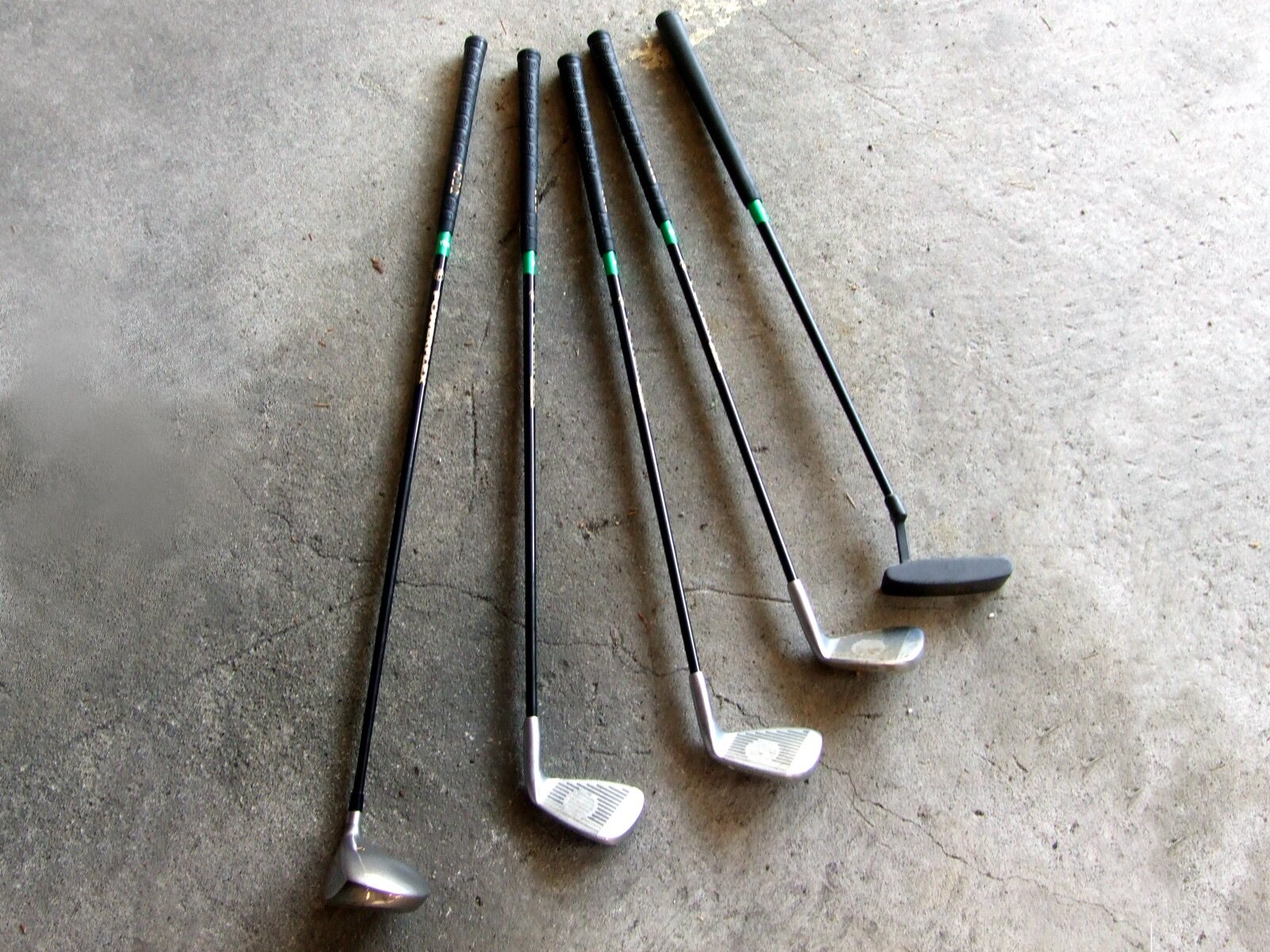

Junior golf club size chart by height
Measure your child standing against a wall in the shoes they will play in, then pick the band. If they sit right at the top of a band and are growing fast, it is reasonable to go one size up; any further and the clubs will be too long.
| Height (inches) | Height (cm, approx.) | Typical stage |
|---|---|---|
| 36 to 39 | 91 to 99 | First swings, toddler and pre-school |
| 39 to 42 | 99 to 107 | First set |
| 42 to 45 | 107 to 114 | First set |
| 45 to 48 | 114 to 122 | Beginner to intermediate |
| 48 to 51 | 122 to 130 | Beginner to intermediate |
| 51 to 54 | 130 to 137 | Intermediate |
| 54 to 57 | 137 to 145 | Intermediate |
| 57 to 60 | 145 to 152 | Intermediate to advanced |
| 60 to 63 | 152 to 160 | Teen, intermediate to advanced |
| 63 to 66 | 160 to 168 | Teen, moving towards adult clubs |
| 66 to 69 | 168 to 175 | Teen, last junior size |
Height bands are from U.S. Kids Golf's fitting guide; the centimetre column is our conversion. Other makers use their own bands or age labels, so always check the height range on the box rather than the age printed on it.
Why height beats age
A junior club is built around three things that all scale with the child: length, total weight and shaft flex. Length decides posture: the right length lets a child stand with a slight knee bend and the arms hanging naturally. Weight decides whether they can control the club at the top of the swing. Flex decides whether the shaft loads and releases at a child's swing speed, which is far below any adult's. Sizing by height gets all three roughly right in one measurement; sizing by age gets them wrong for every child who is tall or small for their year.
How many clubs a junior needs
Far fewer than the 14 the rules allow. A child learns faster with a few clubs they hit well than with a full bag of clubs they cannot tell apart, because the distance gaps between adjacent junior clubs are small.
- First set (under about 107 cm): three or four clubs: a fairway wood or hybrid, a mid iron such as a 7, a putter, and sometimes a wedge. Enough for the range, the putting green and short holes.
- Beginner to intermediate (about 107 to 145 cm): five to seven clubs: add a driver, a hybrid in place of long irons, a pitching wedge and perhaps a second iron.
- Teenager playing full rounds: eight to ten clubs, with a sand wedge, two or three irons and a hybrid. Gaps start to matter, so this is the stage when a fitting is worth it.
Our page on how many clubs to carry covers the 14-club rule and how adults build a bag, which is where a teenager is heading.
Why not cut down an old set of adult clubs?
It is the classic thrifty move, and it causes most of the problems junior sets were designed to solve. Cutting a shaft shorter makes it stiffer, so it will barely flex at a child's swing speed, and it leaves an adult-weight club head on the end, so the club feels heavy and is hard to swing on plane. The grip also stays adult-thick for a small hand. A cut-down 7 iron is better than nothing for an afternoon on the range, but not as a child's set.
The same logic argues against buying clubs to grow into. A club two sizes too long is a cut-down adult club in reverse: the child chokes down the grip, the shaft and head now feel even heavier relative to the shortened grip, and posture suffers. Buy for now, or one band ahead at most.
When to move up a size
- Your child has grown past the top of the height band.
- They hold the club with their hands well down the grip, or the club sole sits toe-up at address because they are too tall for it.
- They are hitting the ball noticeably higher and shorter than they used to, which can mean the shaft is now too soft for their speed.
Children often move up a band every year or two. Junior sets hold their value well on the second-hand market, and many shops and some brands run trade-in schemes, so selling the old set funds much of the next one.
Bags, balls and the rest
Most junior sets come with a bag sized to the clubs; a stand bag is worth having once a child is walking nine holes. Use soft, low-compression balls rather than tour balls, which feel hard and fly no further at junior swing speeds; our golf balls guide explains compression. A junior glove sized to the hand helps grip in damp weather. For the course itself, a junior set does not need anything more: a child with five clubs can play a whole round.
Where juniors can play near Lullingstone
A 9-hole course, a short game area or a driving range is the right place to start, because a child can hit a good shot every few swings and play a full hole without a long walk. Our guide to family golf and a junior's first visit covers how to book and what to expect, and the Valley 9-hole course guide describes the shorter course. If your child is taking lessons, take the clubs along: a coach will tell you in a few swings if the size is wrong. See also what happens in a first golf lesson.
Back to the Lullingstone Park Golf homepage.
Frequently Asked Questions
What size golf clubs does my child need?
Measure their height in shoes and match it to the maker's height band. U.S. Kids Golf uses 3-inch bands from 36 to 69 inches (about 91 to 175 cm); other brands print their own height range on the box.
Should I buy junior golf clubs by age or height?
Height. Children of the same age can differ by 15 cm or more, and length, weight and shaft flex all need to match the child's size, so an age label is only a rough guide.
How many clubs does a junior golfer need?
Three or four for a first set (a wood or hybrid, a mid iron, a putter and perhaps a wedge), five to seven for a developing junior, and eight to ten for a teenager playing full rounds.
Can I cut down adult golf clubs for my child?
It is not recommended. Shortening the shaft makes it stiffer and leaves an adult-weight head and thick grip, so the club is too heavy and stiff for a child's swing.
When should a child move up a club size?
When they grow past the top of their height band, grip well down the handle, or the club sits toe-up at address. Many children move up every year or two.
When can a teenager switch to adult clubs?
Usually once they are past the last junior band, around 168 to 175 cm, and swinging fast enough for regular or senior flex shafts. A fitting at that point is worth the money.