Home › Equipment
Hybrid Golf Clubs: Which Loft Replaces Which Iron, and Why It Flies Higher
Hybrid golf clubs solve a problem most club golfers have but few admit to: the long irons in the bag do not get the ball in the air. A hybrid carries roughly the same loft as the iron it replaces, and yet it launches higher, holds a green better and survives a strike off the toe. This page explains the loft-for-loft swap, why the physics favours the hybrid, how many you can sensibly carry, and how to stop hitting it like a fairway wood.
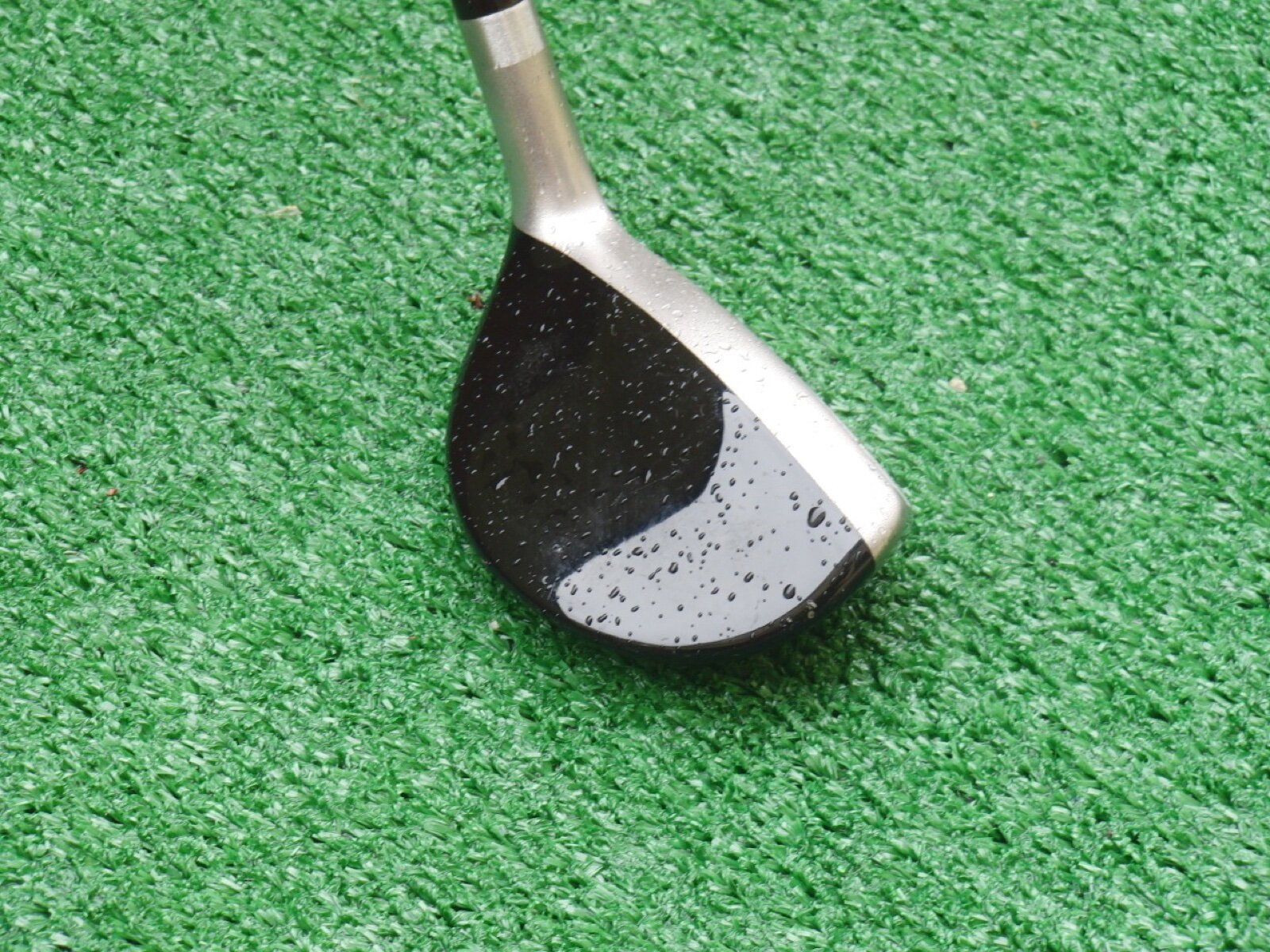
What a hybrid actually is
A hybrid, sometimes still called a rescue club, is a small wood-shaped head fitted with a shaft closer in length to an iron. The head is hollow, the sole is wide, and most of the mass sits low and towards the back. That single design decision is the whole story: the centre of gravity is further from the face and closer to the ground than it can ever be in a forged blade of the same loft.
Everything else follows. A lower and deeper centre of gravity launches the ball higher and spins it a little more, so it lands steeply instead of running through the back of a green. A wider sole skids across turf rather than digging, so a slightly heavy strike still produces a shot. A bigger, more stable head resists twisting on off-centre hits, which is why a toe strike with a hybrid finishes in play and a toe strike with a 3-iron finishes in the trees.
The loft swap, club by club
Hybrids are numbered like irons, but the number is a marketing convention and the loft is the fact. Always buy on loft. A modern set of irons may be two or three degrees stronger than a set from fifteen years ago, so the honest way to slot a hybrid in is to check the loft of the iron above and below it in your own bag.
| Hybrid | Typical loft | Iron it replaces | Also compares with |
|---|---|---|---|
| 2 hybrid | 16 to 18 degrees | 2 iron | 5 wood |
| 3 hybrid | 19 to 21 degrees | 3 iron | 7 wood |
| 4 hybrid | 22 to 24 degrees | 4 iron | 9 wood |
| 5 hybrid | 25 to 27 degrees | 5 iron | - |
| 6 hybrid | 28 to 30 degrees | 6 iron | - |
Two points that surprise people. First, a hybrid and the iron it replaces are not meant to go further, they are meant to go higher and land softer, so expect similar or slightly shorter carry with a much better chance of holding the target. Second, a 19 degree hybrid often launches closer to a 5 wood than to the 3 iron it nominally replaces, because the head shape and the centre of gravity are closer to a wood than to an iron.
How many should be in the bag
The rules cap you at fourteen clubs, and that is the real constraint. Rule 4.1b of the Rules of Golf allows a maximum of fourteen clubs for the round, and carrying more costs two strokes for each hole where the breach happened, up to a maximum of four strokes in a round. In match play the state of the match is adjusted instead.
Within fourteen, the practical answers are simple:
- Mid to high handicap: two or three hybrids, replacing the 3, 4 and often the 5 iron. Almost nobody outside single figures gets full value from a 4 iron.
- Low handicap: usually one, at around 19 to 20 degrees, filling the gap between the fairway wood and the longest iron that still launches properly.
- Beginner: a hybrid instead of a 3 wood is often the better first choice off the deck, because the shorter shaft is easier to control. Our guide to the clubs a beginner actually needs sets out a sensible starter set, and how many clubs go in a golf bag covers the fourteen club rule in more detail.
Hybrid or fairway wood
They overlap, and picking between them comes down to where you actually play the shot from.
- Off a tee on a short par 4: the fairway wood wins on distance, the hybrid wins on finding the fairway.
- Off a tight fairway lie: broadly even, and personal preference decides.
- Out of rough: the hybrid wins clearly. The smaller head and steeper angle of attack cut through grass that wraps around a 3 wood and shuts the face.
- Into a green from 180 to 200 yards: the hybrid wins, because it lands steeply enough to stop.
- From a fairway bunker with a clean lie and a low lip: the hybrid wins, thanks to the sole.
How to hit one, and the mistake nearly everybody makes
The single most common fault is treating a hybrid like a fairway wood: ball pushed forward, a wide sweeping arc, and an attempt to help the ball up. Hybrids are built to be hit with a slight descending blow, like an iron.
- Ball position: about one ball forward of centre, similar to a 5 iron, not off the front foot.
- Setup: stand as you would for a mid iron. Do not reach. The shaft is shorter than a wood for a reason.
- Strike: ball first, then a shallow brush of turf. The wide sole means a small divot is fine and a fat strike is survivable.
- Tempo: resist the urge to swing harder because it is a long club. Extra effort moves the low point behind the ball, which is exactly where the sole then bounces.
Twenty balls on a mat is the fastest way to prove this to yourself. Our driving range and practice area is the place to work through it, and if the strike pattern is not improving on its own, a single session covered in what happens in a first golf lesson will find the cause faster than another bucket.
Buying: what matters and what does not
Loft first, then shaft, then head shape. Everything else is noise.
- Loft: fill the yardage gap you actually have. Measure it on the range rather than guessing from the club number.
- Shaft: hybrid shafts run a little heavier and shorter than fairway wood shafts. Too light and too long is the usual cause of a two-way miss.
- Head shape: a deeper, more wood-like head launches higher and helps out of rough. A shallower, more iron-like head flights lower and suits a stronger player who wants to control trajectory.
- Adjustable hosels: useful if you are between lofts, irrelevant if you are not.
- Secondhand: hybrid head technology has moved slowly, so a five year old model in good condition is genuinely competitive with a new one. Check the face for a worn or dished centre before buying.
Where a hybrid earns its place at Lullingstone Park
Parkland golf in the Darent Valley rewards a club that lands softly. The Castle Course hole by hole guide sets out where the long approaches are, and the pattern is familiar to anyone who plays here: uphill second shots that lose distance to the slope, greens with trees close behind that punish a running ball, and rough that thickens noticeably from late spring. All three favour the club that gets airborne easily and stops.
The comparison to make is honest rather than flattering. If you cannot reliably get a 4 iron to the height of the treeline, that iron is not a scoring club, it is a hazard. Swapping it for a hybrid does not buy distance. It buys a shot that finishes on the green instead of thirty yards past it. See our guide to golf irons for where the rest of the set should sit, and the Lullingstone Park Golf homepage for green fees and tee times.
Frequently asked questions
What loft hybrid replaces a 4 iron?
A 22 to 24 degree hybrid, usually sold as a 4 hybrid. Check the loft stamped on your own 4 iron first, because modern iron sets are often two or three degrees stronger than older ones and the club number alone will mislead you.
Do hybrids go further than irons?
Not usually, and that is not the point. At the same loft a hybrid launches higher and lands more steeply, so carry distance is similar while total distance is often a little shorter. What you gain is a shot that holds the green and a much larger margin for a poor strike.
How many hybrids should I carry?
Most club golfers are best served by two or three, replacing the 3, 4 and sometimes the 5 iron. Low handicap players usually carry one. The hard limit is fourteen clubs in total under Rule 4.1b of the Rules of Golf.
Should a beginner use a hybrid instead of a 3 wood?
Off the ground, yes for most beginners. The shorter shaft is easier to control and the sole is far more forgiving of a heavy strike. A 3 wood still has an argument off the tee if you need the extra distance.
Why do I hit my hybrid thin?
Almost always because the ball is too far forward and the swing is a sweep rather than a slight downward strike. Move the ball back to about one ball forward of centre and hit down onto it as you would with a 5 iron.
Is a rescue club the same as a hybrid?
Yes. Rescue was originally a TaylorMade product name that stuck as a generic term in the UK. Any club sold as a rescue is a hybrid.
Sources
- R&A, Rules of Golf, Rule 4: the player's equipment, for the fourteen club limit and the penalty for a breach.