Home › Golf Guides
Golf Simulator for Home: How Much Room You Need, Which Launch Monitor Type, and What a UK Set-Up Involves
A golf simulator for home is no longer a millionaire's toy: a launch monitor, a net or impact screen, a decent mat and a laptop or projector will let you practise and even play full courses in a garage, spare room or garden building. The limit is almost always space, not money. Before you buy anything, you need to know whether you can swing a driver in the room, which type of launch monitor suits its shape, and, if you are building a garden room for it, what UK planning rules allow. This page goes through each in turn.
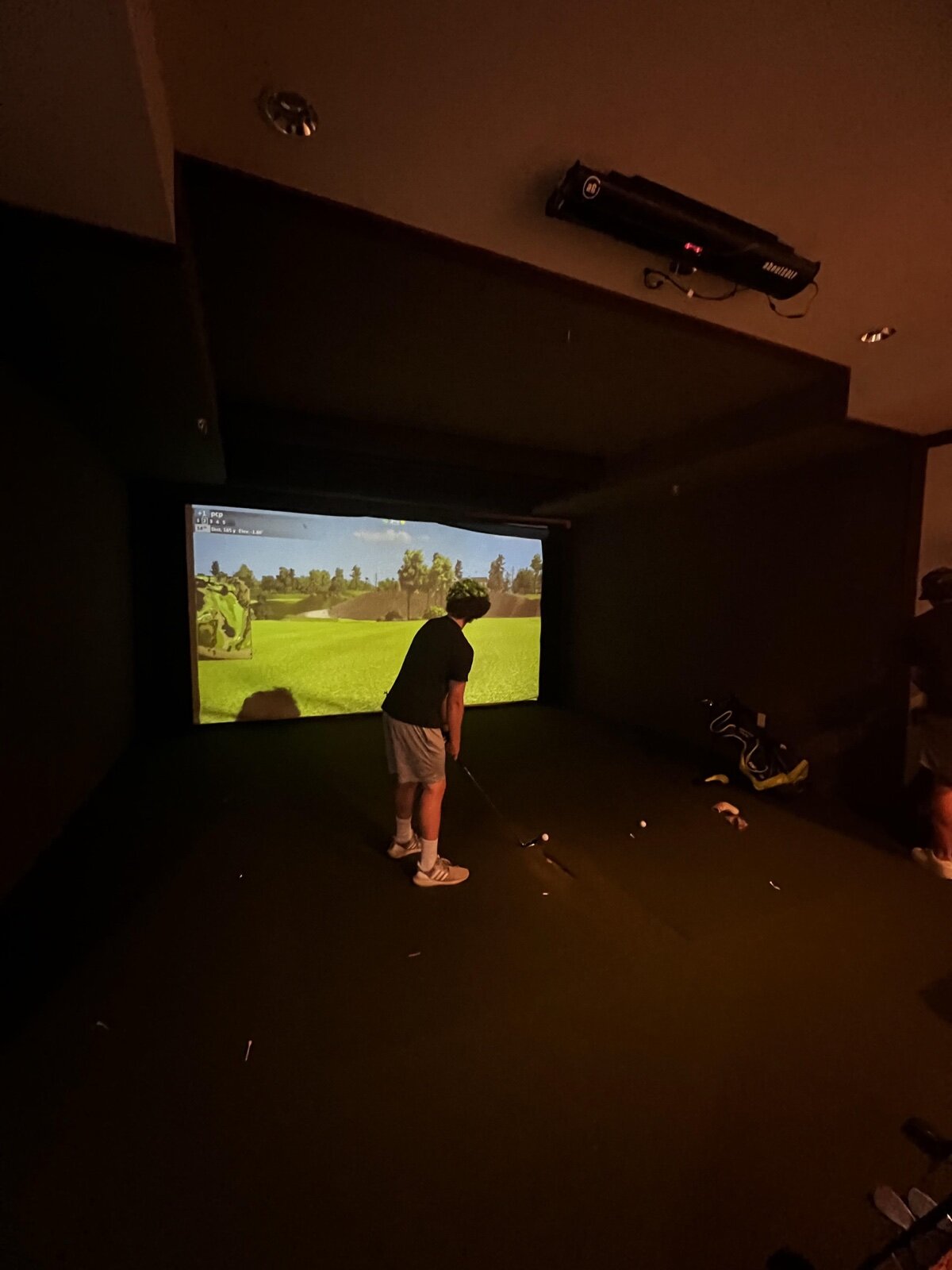

The four parts of a home golf simulator
- A launch monitor measures what the ball (and sometimes the club) does at impact: ball speed, launch angle, spin, direction. It is the heart of the system and where most of the money goes.
- Somewhere to hit into: a net for a basic set-up, or an impact screen inside an enclosure if you want to project the picture.
- A hitting mat that is kind to your wrists and lets you use a real tee.
- Software and a display: a phone, tablet, laptop or TV for numbers and practice ranges, or a projector for full-size courses.
You can start with the first three and a phone, then add an enclosure, projector and course software later.
How much room you need
Ceiling height is the measurement that rules out most rooms. Take your driver into the space and make slow, full practice swings in your normal posture. If you touch the ceiling or a light fitting, the room will not work for full swings, however good everything else is. As a rule of thumb, most adults need a ceiling of around 2.7 to 3 metres for a driver; shorter players and those with flatter swings can manage with less, and you can still hit irons and wedges in a lower room.
| Dimension | What to check |
|---|---|
| Height | A full, unhurried driver swing without touching anything. Allow for the mat raising you by a few centimetres. |
| Width | Room to swing without hitting a side wall, plus a margin either side of the screen for mishits. A left-handed and right-handed household needs the hitting position central. |
| Depth | Space behind you for the swing (and for a radar unit, if you use one), the distance from ball to screen, and a gap behind the screen so a ball does not hit the wall through it. |
Depth depends heavily on the type of launch monitor, which is the next decision.
Radar or camera: which launch monitor suits your room
Radar (Doppler) launch monitors
Radar units track the ball in flight and sit behind the golfer, pointing down the target line. Retailers' set-up guides for popular models such as the Garmin Approach R10 typically place the unit around 6 to 8 feet (roughly 1.8 to 2.4 metres) behind the ball, and radar needs some ball flight to read, so these units want a deeper room. They are usually the cheapest way in and also work outdoors at the range.
Camera (photometric) launch monitors
Camera units photograph the ball, and in some cases the club, at impact. They sit beside the ball or are mounted overhead, so they do not need space behind you, and they read spin directly rather than estimating it. That makes them the better choice for a shallow garage or spare room. They tend to cost more, and side-mounted units have to be moved for left-handed players, while overhead units do not.
Whichever you choose, check three things before buying: the minimum room size the manufacturer states, whether it measures spin or calculates it, and what the course software costs. Some systems include practice modes and courses; others need an annual subscription to play full rounds.
Screens, nets and enclosures
A free-standing net is the simplest option and fine for practice using numbers on a phone or tablet. For a projected picture you need an impact screen, ideally inside an enclosure with side and top netting to catch mishits. Leave a gap of at least several centimetres, more if you can, between the screen and the wall behind it, and hang the screen loosely enough to absorb the ball. Padding or netting on the side walls protects the plaster and anyone watching.
Projectors for simulators are usually short-throw models mounted on the ceiling above or just in front of the hitting area, out of the swing path. Mount it so you do not cast a shadow on the screen when you address the ball.
Mats: the part people under-spend on
Hitting off a thin mat on a concrete garage floor jars the wrists and elbows, and a mat that lets you get away with a heavy strike will flatter your numbers. Choose a thick mat with a forgiving hitting strip that accepts a real tee, and put it on a level base. If you also want to work on putting, our guide to putting mats covers what to look for.
Garage, spare room or garden room?
- Garage: the usual choice, with a hard floor and room to hang an enclosure. Check the ceiling height against the up-and-over door mechanism, which often sits lower than the roof.
- Spare room or loft: often too low for a driver, but workable for irons, wedges and putting with a camera-based unit.
- Garden room: lets you design the space around the swing, but UK planning rules limit the height.
The UK garden room rules that matter
In England, most garden buildings can go up under permitted development without a planning application, within limits set in Class E of the General Permitted Development Order. The one that catches out golfers: if any part of the building is within 2 metres of a boundary, the whole building can be no more than 2.5 metres high. Further from the boundary, the limit is 4 metres for a dual-pitched roof or 3 metres for any other roof, with eaves no higher than 2.5 metres. A building also cannot sit in front of the principal elevation of the house, and outbuildings together cannot cover more than half the garden.
A 2.5 metre external height leaves too little inside for most people to swing a driver, so either set the building at least 2 metres from the boundary, sink the floor, or apply for planning permission. Listed buildings, flats and some designated areas have tighter rules, so check with your council. On building regulations, a detached outbuilding under 15 square metres with no sleeping accommodation is generally exempt, and one of 15 to 30 square metres can be too if it is at least a metre from the boundary or built mainly of non-combustible materials.
Getting the most out of it
A simulator is best used as a practice tool, not just a game. Work on one thing per session: start-line control, a stock wedge distance, or reducing spin with the driver. Check your carry distances for each club and write them down for the course; our guide to golf irons explains gapping. Then take what you have learned outside. Indoor numbers do not account for wind, slopes or wet winter turf, so test them on the real thing at our practice area or on the course. For a cheaper start in the garden, see our guide to golf nets for the garden, or go back to the Lullingstone Park Golf homepage.
Sources: GPDO 2015, Schedule 2 Part 1 Class E (outbuildings); Planning Portal, outbuildings; Building Regulations 2010, Schedule 2 (exempt buildings).
Frequently Asked Questions
How much space do I need for a golf simulator at home?
Ceiling height is the key: most adults need around 2.7 to 3 metres to swing a driver. Depth depends on the launch monitor; radar units sit behind the golfer and need a deeper room than camera units, which sit beside or above the ball.
Can I put a golf simulator in my garage?
Usually, yes. Check the ceiling height against the door mechanism, put a thick mat on a level base, and hang an enclosure or net with a gap in front of the back wall.
Do I need planning permission for a golf simulator garden room?
Often not in England, under Class E permitted development, but if any part is within 2 metres of a boundary the whole building is limited to 2.5 metres high, which is usually too low for a driver.
Is a radar or camera launch monitor better indoors?
Camera units suit shallow rooms because they sit beside or above the ball and measure spin directly. Radar units are often cheaper but need space behind the golfer and some ball flight.
Can I practise putting on a home simulator?
Many systems include putting, but a dedicated putting mat is often the better tool for distance and line control.