What Is Par in Golf? Birdies, Bogeys and Scoring Explained
A plain-English guide to par and golf scoring for anyone booking a first round at a pay and play course
If you are new to golf, the scorecard can look like a foreign language. The single word that unlocks it is par. Once you understand what par in golf means, terms like birdie, bogey and eagle fall into place, and you can keep score on your first round without any confusion. This guide explains par, the scoring words that go with it, and how handicaps let beginners and experienced players enjoy a game together, all in plain English.
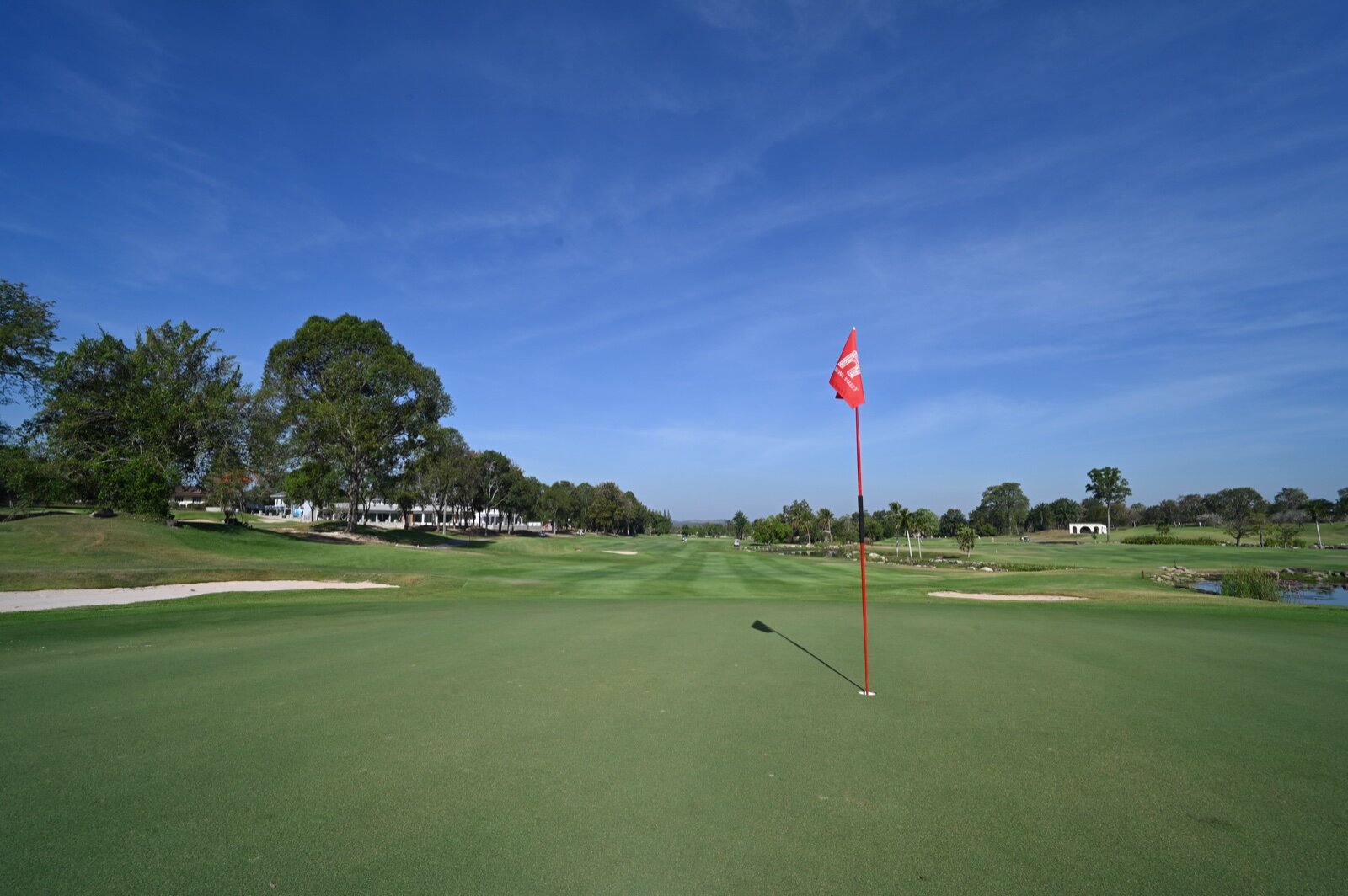
A hole and flag on the green. Photo: Golf green with flag by PattayaPatrol (CC BY-SA 4.0), via Wikimedia Commons.
What par actually means
Par is the number of strokes a very good golfer, playing well, would be expected to take to finish a hole. It is built from the shots needed to reach the green plus two putts to hole the ball. So a hole where a strong player reaches the green in one shot is a par 3 (one shot plus two putts), a hole that takes two shots to reach is a par 4, and a long hole needing three shots is a par 5.
What decides the par of a hole is mainly its length. Roughly speaking, short holes are par 3s, medium holes are par 4s, and the longest are par 5s. Add the par of every hole together and you get the course par: for a full 18-hole course this is usually somewhere around 70 to 72. Lullingstone Park has two layouts, the 18-hole Championship Course and the 9-hole Valley Course, so the round you book sets the total par you are playing to.
Birdies, bogeys and the rest
Every golf scoring word simply describes how your score on a hole compares with its par. The under-par terms are named after birds:
- Par: you matched the par exactly.
- Birdie: one stroke under par.
- Eagle: two strokes under par.
- Albatross: three strokes under par, and very rare.
- Hole-in-one: holing your very first shot, most often on a par 3.
Scores over par have their own names too:
- Bogey: one stroke over par.
- Double bogey: two over par.
- Triple bogey: three over par.
So if you take five shots on a par 4, that is a bogey; four shots on a par 5 is a birdie. That is really all there is to the scoring language.
How a round is scored
The most common format is stroke play, where you simply count every shot you take across all the holes and add them up. Your total against the course par tells the story: level par is excellent, a few over par is a strong club round, and well over par is where most people playing for fun will sit. There is also Stableford scoring, popular in club competitions, where you earn points based on your score at each hole rather than counting every stroke, which is kinder on a bad hole because you can simply pick up and move on.
For a first outing, do not worry about the number. Count honestly, enjoy the good shots, and let the rest go. A relaxed nine holes on the Valley Course is a fine place to learn to keep score before tackling a full 18.
What is a good score, and how handicaps help
Most beginners score well above par, which is entirely normal. Over 18 holes, breaking 100 is a common first milestone, breaking 90 marks a solid golfer, and breaking 80 is genuinely good. The reason players of wildly different standards can still enjoy a match together is the handicap system. A handicap is a number reflecting your standard, worked out from your recent scores under the World Handicap System. In a game the higher-handicap player receives more strokes, deducted from their gross total to give a net score, so a beginner and a seasoned golfer can finish neck and neck. England's governing body, England Golf, oversees handicapping for club members.
Ready to put it into practice
The best way to learn scoring is to play. As a pay and play course, Lullingstone Park lets you book a tee time and turn up without being a member, so it is an ideal place to try keeping score for the first time. See our green fees and booking guide, read about the Championship Course and Valley Course, or head back to the Lullingstone Park homepage to plan your round.
Frequently Asked Questions
What does par mean in golf?
Par is the number of strokes a very good golfer is expected to take to complete a hole, or a whole course. It is made up of the shots to reach the green plus two putts. Holes are set as par 3, par 4 or par 5 depending on their length, and adding every hole together gives the course par, which is usually around 70 to 72 for a full 18-hole course.
What is a birdie, bogey and eagle?
These describe your score on a hole compared with its par. A birdie is one under par, an eagle is two under, and the rare albatross is three under. Going the other way, a bogey is one over par, a double bogey is two over, and a triple bogey is three over. Matching the par exactly is simply called a par.
What is a good golf score for a beginner?
Most beginners score well above par, and that is completely normal. Breaking 100 over 18 holes is a common first big milestone, breaking 90 marks a solid club golfer, and breaking 80 is very good. On a nine-hole round, aim to enjoy it and count honestly rather than chase a number. The handicap system exists precisely so players of different standards can compete fairly.
How does a golf handicap work?
A handicap is a number that reflects your playing standard and lets golfers of different abilities compete on level terms. It is worked out from your recent scores under the World Handicap System. In a game, a higher-handicap player receives more strokes, which are deducted from their gross score to give a net score, so a beginner and a low handicapper can have a genuinely close match.