Spiked vs Spikeless Golf Shoes: Which Pair Suits a Kent Course?
What the Rules actually ban, what the ground in Kent actually demands, and how to buy once
The choice between spiked golf shoes and spikeless ones is usually presented as a style question. It is not. It is a ground-conditions question, and in Kent the ground changes completely between July and January. A spikeless shoe is comfortable, light and perfectly grippy on dry summer turf. A spiked shoe holds you still on a wet downhill lie in February, which is when most amateur swings fall apart. This guide explains the difference, what the Rules of Golf actually say about spikes, and how to pick a pair you will still be wearing in three years.
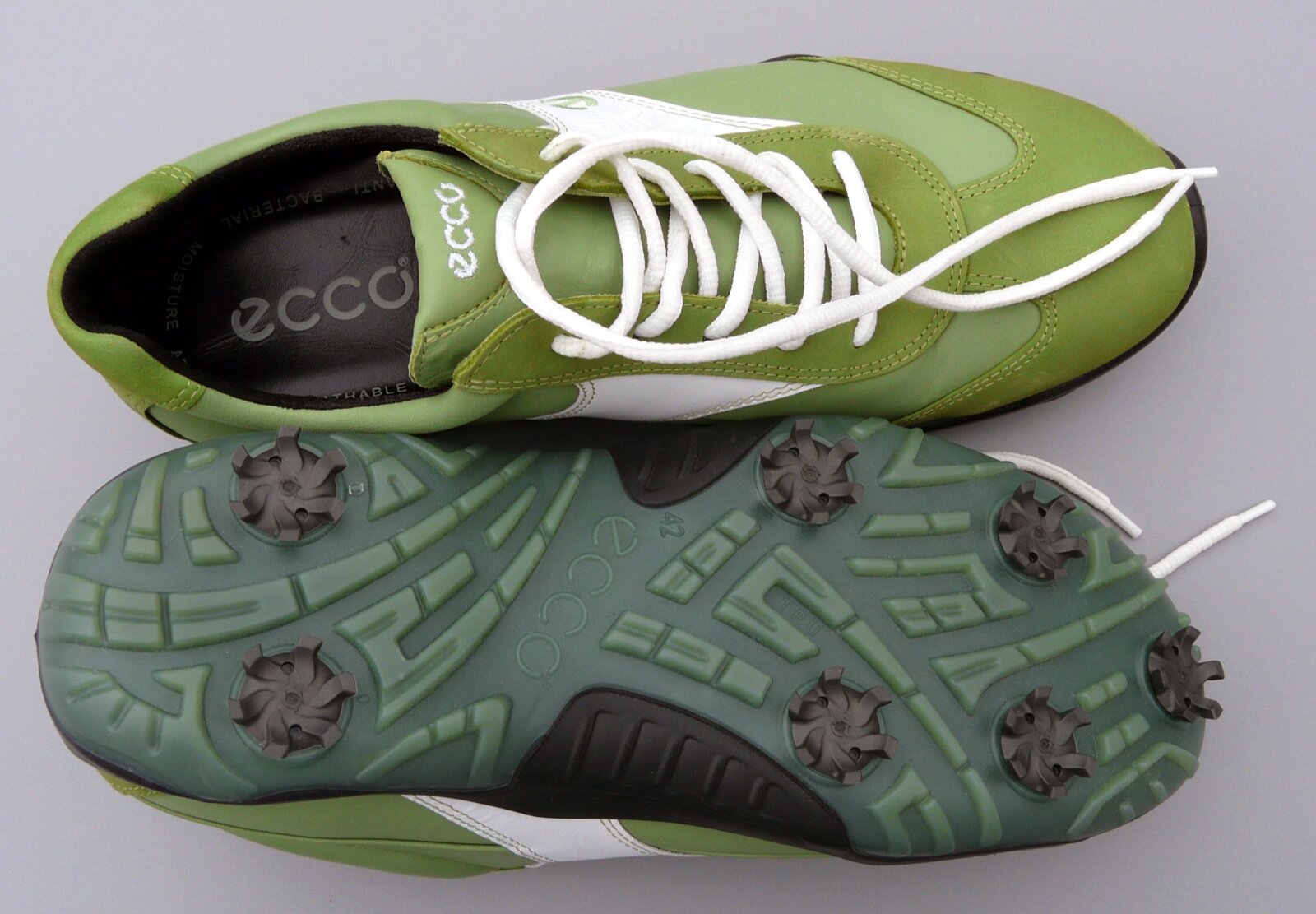
A conventional spiked golf shoe, sole up: the seven replaceable cleats are the part that wears out. Photo: Golfschuhe 1 (fcm) by Frank C. Müller (CC BY-SA 3.0), via Wikimedia Commons
The short answer
If you play all year round on a parkland course, buy spiked. If you play mostly in summer, or you want one pair that walks to the clubhouse and the car park without a change, buy spikeless. If you can only own one pair and you live in the south east of England, spiked is the safer buy, because the months when spikeless struggles are the months when the course is quiet and cheap and you are most likely to be out on it.
What the Rules of Golf actually say
This trips people up, so it is worth being precise. The Rules of Golf do not ban metal spikes. What exists instead is a model local rule, published by the R&A and USGA in Section 8 of the Committee Procedures as Model Local Rule G-7, which allows a committee to prohibit shoes with metal or traditionally designed spikes on its course. Nearly every club in Britain has adopted it, because studies from the 1980s onwards found that metal spikes compacted soil and chewed up greens far more than rubber alternatives, and greenkeeping budgets never recovered from the argument.
The practical upshot for a visitor: soft spikes, made of plastic or rubber, are welcome everywhere. Metal spikes are not, and turning up in them is the fastest way to be sent back to the car park. You can read the Rules in full at randa.org.
Spiked shoes: what you are actually buying
A spiked shoe has separate cleats screwed into threaded sockets in the outsole, usually seven to nine per shoe, arranged around the heel and the ball of the foot. The cleat itself is a small plastic star or a set of flexible legs that splay under load and bite into the turf.
- The advantage is lateral hold. A golf swing pushes your weight sideways and then rotates it. On soft ground, a moulded rubber lug skids fractionally before it grips; a cleat does not. The difference is small on a flat lie and obvious on a slope.
- They are repairable. When the cleats round off, you unscrew them with a spike wrench and fit new ones for a few pounds. A spikeless shoe with a worn outsole is scrap.
- They are heavier and stiffer. That stiffness is part of the point, since it stops the foot rolling, but it makes them less pleasant for the walk from the car.
- You should not walk on hard surfaces in them. Car parks and paths wear cleats faster than a whole season of fairways.
Spikeless shoes: what changed
Spikeless golf shoes were a novelty fifteen years ago and are now the bigger half of the market. The traction is moulded straight into the outsole as rubber lugs, nubs or a dimpled pattern, so the shoe looks like a trainer and behaves like one off the grass.
- Comfort and weight. They are lighter, flex more naturally over four or five miles of walking, and need no breaking in.
- One pair, all day. Drive to the course, play, eat in the clubhouse, drive home. No shoe bag.
- Traction is close, not equal. On dry or firm ground the gap has genuinely closed. On saturated winter turf it has not.
- They wear out as a unit. When the lugs go smooth, usually after a couple of seasons of regular play, the shoe is done.
The Kent calendar test
A useful way to decide is to think about when you actually play rather than what looks best. Kent parkland courses hold water through the winter and dry hard by mid-July, so the year splits roughly in two.
- May to September: firm fairways, short dew, spikeless is ample and more comfortable.
- October to April: soft ground, heavy dew until late morning, standing water after rain. This is spiked weather, and it is also when green fees are at their lowest, so it is when a lot of rounds get played.
- All year: if you only buy one pair, buy the pair that works in the harder half of the year.
Course condition and what winter golf involves is covered in more detail on our page about course condition through the seasons.
Fit and waterproofing matter more than the sole
Most people buy the wrong size. A golf shoe is worn for four or five hours of walking, largely on uneven ground, and feet swell. Try shoes on late in the day, wear the socks you will play in, and leave a thumb's width in front of the longest toe. The heel should not lift when you rock forward onto the ball of the foot, because heel slip is what causes blisters on the back nine.
For year-round golf in England, a waterproof membrane is not a luxury. Manufacturers usually attach a stated waterproof warranty, commonly one or two years, and that number is a fair proxy for how seriously the shoe is constructed. Treat it as a build-quality signal rather than a promise. Wet feet at the sixth turn a good round into a long walk.
Looking after them
- Knock the mud off before it dries. A stiff brush and cold water, never a radiator, which cracks the upper and unsticks the sole.
- Stuff them with newspaper to dry, and dry them slowly and away from direct heat.
- Check the cleats every few rounds. Rounded tips mean replace, and a seized cleat is far easier to remove before it corrodes in.
- Carry a spike wrench in the bag. A cleat that works loose mid-round is a five minute fix or a ruined round.
What Lullingstone Park expects
Lullingstone Park is a public pay and play course, so the footwear expectation is sensible rather than strict. Golf shoes with soft spikes or a spikeless sole are ideal, flat trainers are generally accepted, and metal spikes, football boots and heavy walking boots are not. Our golf course dress code page covers the rest of the kit, the first-time visitor guide deals with buggies and directions, and you can plan a round from the Lullingstone Park homepage.
Frequently asked questions
Are spiked golf shoes allowed on UK golf courses?
Yes, as long as the spikes are soft. Modern golf shoes take plastic or rubber cleats, and those are welcome everywhere. What is not allowed at almost every UK club is a metal or traditionally designed spike. The Rules of Golf do not ban them outright; instead the R&A and USGA publish Model Local Rule G-7, which lets a committee prohibit them, and nearly every course has adopted it.
Do I need spiked golf shoes to play golf?
No. On a dry summer course a decent spikeless shoe gives all the grip most club golfers need, and plenty of people play in trainers on a public pay and play course. Spikes earn their place when the ground is soft, the grass is wet or the lies are sloping, which in Kent means roughly October to April.
What is the difference between spiked and spikeless golf shoes?
A spiked shoe has separate cleats screwed into the sole, usually seven to nine of them, and they can be unscrewed and replaced when they wear down. A spikeless shoe has traction moulded into the outsole as rubber lugs, nubs or a dimpled pattern. When those wear smooth the shoe is finished, but it is lighter, more comfortable off the course and does not need maintaining.
How long do golf shoe spikes last?
Soft spikes are a wearing part. If you play weekly, expect to change them once or twice a season, and sooner if you walk on car parks and paths in them. The signs are obvious: the tips go rounded instead of sharp, and you start feeling the shoe move on a downhill lie. A spike wrench and a bag of replacement cleats cost less than a round.
Can you wear trainers instead of golf shoes?
At a relaxed public pay and play course like Lullingstone Park, flat-soled trainers are generally fine, and they are the sensible starting point if you are not yet sure golf will stick. Avoid football boots, walking boots and anything with a metal stud, which damages greens. Once you play regularly, a proper golf shoe is the cheapest shot you will ever buy back.
Are waterproof golf shoes worth it in the UK?
For year-round play in Kent, yes. A round is four or five miles across grass that holds dew until late morning for much of the year, and wet feet at the sixth is a long walk home. Look for a stated waterproof warranty, usually one to two years, and treat it as a guide to how seriously the shoe is built rather than a guarantee.
Sources
- R&A, the Rules of Golf, including the Committee Procedures that contain Model Local Rule G-7: randa.org
Checked on 18 September 2026.